Trade Union demands for UNCSW70: Access to Justice for Women in the World of Work
Thursday, Nov 20, 2025
Access to justice should effectively address women's exploitation in the world of work and the discriminatory working conditions they face based on gender. Trade unions call on the CSW70 Agreed Conclusions to include a bold commitment to the ratification and effective implementation of international labour standards linked to the ILO's fundamental principles and rights at work for all women.
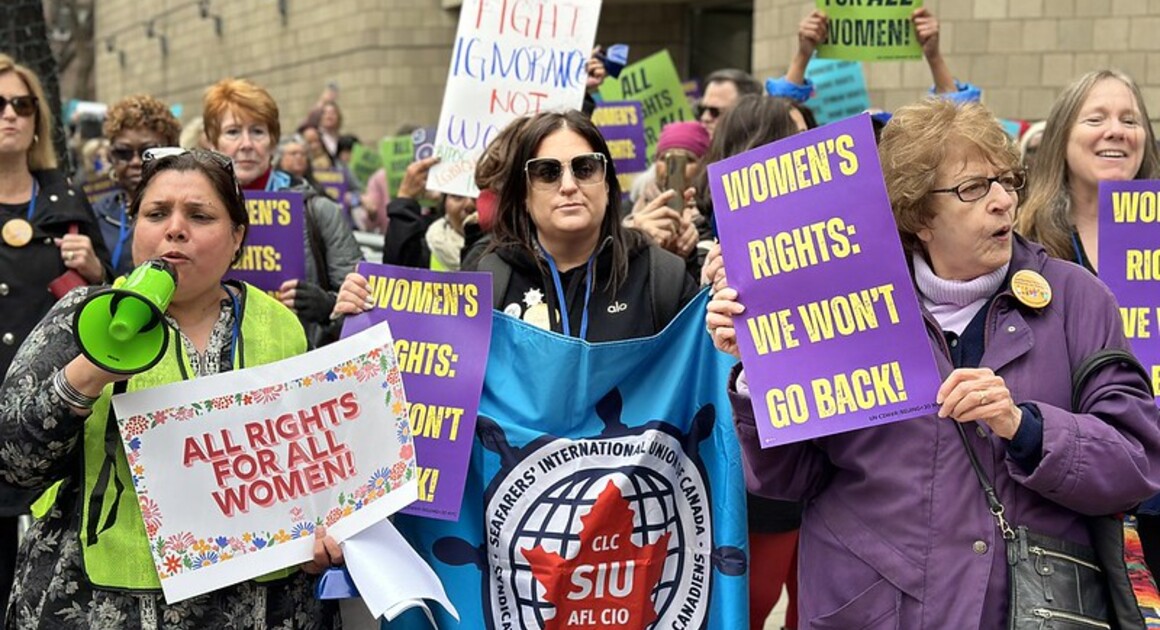
Access to justice for women sustains peace and democracy. This right is enshrined in the Convention on the Elimination of All Forms of Discrimination against Women (CEDAW). Access to justice is also recognised by Sustainable Development Goal (SDG) 16 as essential for democracy. However, gender discrimination is reflected in women’s uneven access to legal systems, discriminatory laws and policies and structural barriers to women’s equitable access to institutions and decision-making processes.
We call on governments to recognise and support the role of trade unions in ensuring access to justice for women, both within and beyond the workplace. Ensuring that all workers, in particular those most affected by discrimination, exclusion and exploitation, can effectively exercise their right to join a union and bargain collectively is critical.
The CSW70 Agreed Conclusions must include concrete commitments to build a world free of all forms of discrimination, including multiple and intersecting forms of direct and indirect discrimination, violence and harassment. We call for gender-responsive justice institutions that are effective, accountable, adequately financed and based on reliable data. However, effective access to justice for women and girls cannot be achieved solely by tackling discrimination within and around justice systems. It also requires legal and policy measures that address the discrimination and inequality women and girls face in the world of work and in society at large.
Given the interconnection between democracy and justice, governments must commit to protecting democracy everywhere and reversing the shrinking civic space for trade unions and civil society organisations. They must ensure the conditions for the full exercise of all human rights are enjoyed by all, including women and girls in all their diversity. This is the only way to dismantle structural barriers faced by women at the intersections of class, gender, race, ethnicity, sexual orientation, gender identity, age, and migrant, Indigenous and disability status.
In the framework of promoting sustainable peace, in line with the Beijing+30 Declaration (paragraph 15 (k)), we call for ensuring access to justice for victims and survivors of all forms of violence, “including sexual and gender-based violence and sexual violence in conflict”. We equally call for the implementation of International Labour Organization (ILO) Recommendation 205, which requires applying a gender perspective in all crisis prevention and response efforts, including support for victims’ socio-economic and labour market reintegration.
Acess to justice is a direct means of implementation of women's labour rights
Access to justice should effectively address women's exploitation in the world of work and the discriminatory working conditions they face based on gender.
Trade unions call on the CSW70 Agreed Conclusions to include a bold commitment to the ratification and effective implementation of international labour standards linked to the ILO's fundamental principles and rights at work for all women. This is a key means of "promoting, respecting, protecting and fulfilling women's rights to work and rights at worl<' in line with Beijing+30 Declaration (paragraph 15 (a)).
"Enforcing labour rights, including the right to organize and bargain collectively," as acknowledged by the Beijing+30 Declaration, is crucial to achieving decent work for women. Freedom of association and collective bargaining are important not only for preventing disputes from escalating, but also for establishing fair and effective settlement procedures. These enabling rights must be respected, promoted and enforced for all workers, including those in supply chains, migrant workers, as well as those in the informal economy, in both rural and urban areas, and in public and private sectors.
Effective justice institutions are essential to improve compliance with these rights and to tackle the persecution of women trade union leaders in line with SDG 16.10.1.
Justice systems, both internal and external to the workplace (including labour courts and labour inspection systems), must provide expeditious labour dispute prevention and resolution, with full respect for due process. They must also be equipped through systematic training and guidance to ensure equality and non-discrimination in access to labour justice; eliminate gender stereotypes (which often lead to secondary victimisation of those reporting abuse), and provide effective legal remedies and access to psychosocial or other services.
Moreover, access to justice must be adequately financed: Member states should make the claims process affordable by waiving fees and by investing in dedicated legal aid for women, including for labour and employment claims.
It is of vital importance that gaps are addressed in access to labour justice in global supply chains, where women are often overrepresented in most precarious jobs, with no rights - including the right to join trade unions and be covered by collective bargaining agreements. There is a need for accessible, safe, fair, effective, and impartial dispute resolution mechanisms, both judicial and non-judicial, with due account taken of the fact that multinational corporations operate across jurisdictions. Support for the development of the UN Business and Human Rights Treaty, as well as national and regional Human Rights Due Diligence laws, is essential.
Women's capacity building, including legal literacy, must be promoted and adequately financed to equip all women and girls with the tools to claim and exercise their rights, including labour and union rights. This must be part of a broader commitment to equal access to universal, inclusive, equitable, gender-transformative, and quality education for women and girls, in all their diversity and throughout their life course.
Promoting women's equitable participation and representation in leadership roles and in decision-making processes related to law and policymaking, monitoring and review - including through social dialogue and collective bargaining - is equally key. We call for the removal of structural barriers to women's participation as professionals within judicial systems and justice-related services, where they remain underrepresented, including through the temporary adoption of quotas.
Economic justice for women starts with decent work
Decent work is essential for women's access to economic justice. However, multiple and intersecting forms of discrimination against women directly affect their opportunities throughout the employment cycle, in accessing, remaining and progressing through decent work.
We call on governments to undertake legal and policy reforms, backed by adequate and sustainable investments, to realise equal opportunities for women for full and productive employment and decent work, in line with SDG 5 and 8.
Such policies must extend the scope of application of labour legislation to women in precarious or informal work, to facilitate women workers' transition to the formal economy in line with ILO Recommendation 204 and with the ILO Resolution concerning the transition to formality (2025). Moreover, they must promote women's occupational safety and health, as well as "equal access both in law and in practice to gender-responsive comprehensive and universal social protection systems, including floors," as established by the Beijing+30 Declaration (paragraph 15 (e)).
Quality and affordable public services, including universal access to quality public health, care, education and lifelong learning, water, transport, energy and communication infrastructure, function as equalisers in society and are instrumental to the enjoyment of women's human and labour rights.
Given the centrality of national comprehensive care systems to advancing women's participation in the labour market, trade unions call for the ratification and implementation of the international labour standards relevant to the care decent work agenda, including ILO Convention 177 (home work). In line with the 2024 ILO Resolution concerning decent work and the care economy, CSW70 must recognise the State's "primary responsibility for care provision, funding, regulation and ensuring high standards of quality, safety and health for care workers and care recipients." Moreover, it must reaffirm the Beijing+30 Declaration's commitment to reduce, recognise and redistribute unpaid care work, while rewarding and ensuring the representation of paid care workers; prioritise public investments in care; and to provide "universal care and support services throughout the life course" (Paragraph 15 {b)) including through collective bargaining and social dialogue.
Trade unions call on member states to recognise care as an autonomous, stand-alone human right, as recognised by the Inter-American Court of Human Rights' Advisory Opinion OC-31/25 (2025), and to implement special measures to ensure the full enjoyment of labour rights by care workers, as well as workers with family responsibilities
Concerning access to justice in the context of digitalisation, we call for regulatory frameworks that promote the "full respect for the human rights of all women and girls, both online and offline" and mainstream the gender perspective in policy decisions guiding the development of digital technologies, including artificial intelligence, in line with Beijing+30 Declaration (paragraph 15 (c)). Trade unions support the adoption of an ILO Convention and Recommendation on platform work, as decided by the ILO Conference 2025. Investments in education and access to technology to close the digital gender divide are equally crucial.
Trade unions call for CSW70 Agreed Conclusions to include systemic and structural approaches to close the gender pay gap, including for workers in non-standard forms of work and the self-employed. Ratification and effective implementation of ILO Conventions 100 (equal remuneration) and 111 (non-discrimination) should be prioritised. Strategies on equal pay should include establishing minimum living wages through statutory processes or collective bargaining; pay equity and anti-discrimination legislation; pay transparency laws, and quotas or targeted initiatives to train, recruit and retain women in underrepresented sectors, such as STEM. Revaluing feminised occupations and sectors is also critical.
Promoting collective bargaining, social dialogue and the active participation of women leaders in union structures is crucial. Effective monitoring and enforcement of equal pay legislation should be achieved through dispute prevention and resolution, strengthening of labour inspection, minimum wage-setting procedures, registration or extension of collective agreements and contract compliance, appropriate legal frameworks for bringing complaints, awareness raising campaigns and accessible complaints procedures, new skills classification systems, and full salary data transparency at both the public and private levels.
Given the Beijing+30 Declaration's call on "taking effective action against violence and harassment in the world of work", CSW70 Agreed Conclusions must commit to the ratification of ILO Convention 190 and its effective implementation, together with ILO Recommendation 206. Governments must enact comprehensive and intersectional strategies that explicitly prohibit all forms of gender-based violence and harassment in the world of work, including domestic violence and femicide. These strategies must protect all workers, including those in informal or precarious employment, and address gender-based violence and harassment across the whole "world of work," beyond the physical workplace.
Trade unions demand safe, confidential, and gender-responsive reporting and complaint mechanisms, with protection from retaliation for victims and witnesses. Justice systems should ensure that labour inspectorates and courts possess expertise on gender-based violence and harassment, offer timely and efficient processing, provide legal assistance for complainants and victims, and allow for the shifting of the burden of proof, as appropriate, in non-criminal proceedings. These policies should be adequately financed and include support for survivors, by ensuring job and earnings security, offering protective work arrangements and hold perpetrators accountable.
Regular training and awareness-raising activities for workers and employers are needed, both for prevention and for effective access to justice and remedies. The involvement of trade unions in the design, monitoring, and enforcement of policies is critical to ensuring that measures are both effective and worker-centred.